What do you think a doctor looks like? Here is what google thinks:
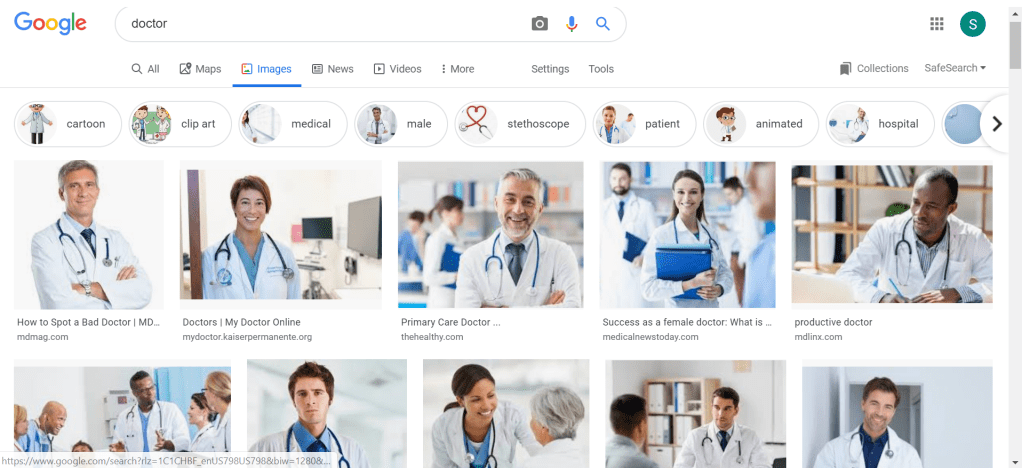
You’ll notice something about these images. Every single person wears a white coat, a stethoscope, most wear a smile. The majority are men, white men. And in the US, this is pretty similar to the statics we have: 69.8% of doctors are white, 61.6% of doctors are men and honestly, that sucks. (1)
But let’s look at a broader picture of medicine. The US is not the only place in the world with doctors, right? After all, article 25 of the UN declaration of human writes states:
“Everyone has the right to a standard of living adequate for the health and well-being of himself and of his family, including food, clothing, housing and medical care and necessary social services.”
So what do we think doctors look like in other countries. First, I decided to ask what google images thought. I went to google.com.mx , searched medico and looked at the image results. (I recognize this isn’t peak investigative journalism, but I do believe it served its purpose)
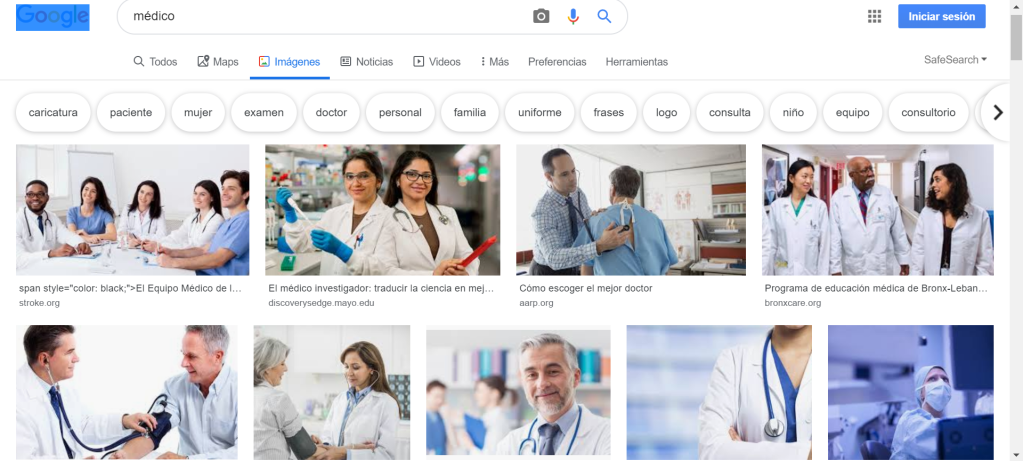
Similarly, we see white coats, fake smiles, and stethoscopes. And interestingly enough, when you click on the links, they are Spanish web results for mostly american companies. Still, something has changed. In the top right image, you can see it’s an add for a medical service in the Bronx, but there are now doctors of color. It is reassuring to know there are resources in the United States for Spanish speaking populations, especially in areas such as the Bronx, which is over 53% Hispanic. However, it is stressful that Latin@ doctors only tend to pop up when you search in Spanish. Moreover, if I’m on google mexico, where are the doctors in Mexico? Who are they? What do they look like? And how do I find them?
The answer took me to some dark zones of internet statistics and even darker zones of health economics books (yikes!), and finally brought me back to the question, what even makes a doctor a doctor?
The answer to this question is different around the globe. So different, in fact that someone can be working in a country practicing medicine for years, only to move to another country and have to basically redo their degrees. This highlights a dangerous double standard in the medical industry. While doctors from other countries struggle have their degrees accepted, doctors with United States degrees can practice in other countries with relative ease. One US doctor remarked about his experience practicing in New Zealand:
The agency “just made everything so easy. They took care of all of the credentialing, visas, and passports. All [he] had to do was show up at the airport. Even [his] rental car was waiting for [him] at the airport when [he] got to New Zealand.”
Dr. Butler – an obstetrician/gynecologist (OB/GYN)
At the same time, humanitarian International Non-Governmental Organizations (INGO) like Doctors Without Boarders (MSF) send doctors with foreign degrees to provide aide in times of need. While humanitarian aide can be beneficial, reliance on foreign aide can destabilize the startup of an industry in a “developing place.” Unlike medical missionary organisation which often function in order to provide care and converstion, MSF states in their charter: “Members undertake to respect their professional code of ethics and to maintain complete independence from all political, economic, or religious powers.” Still, these doctors inherently are practicing dangerous imperialist behavior, which range from working directly with the CIA to providing temporary care without any long term logistical planning, thus creating a damaging dependence. (For a deeper analysis on the imperialist powers of INGOs, check out this article.)
The imperialist nature of health science is not a new thing. There is a long history of healthcare being used as an imperialist practice. There are many ways this plays out. One important way is that advances in a nation’s health and sanitation practices and the implementation of these allows allows the nation to conquer a previously unconquerable area. A clear example of this is shown below.
In his 1913 book, The Triumph of American Medicine in the Construction of the Panama Canal, author J. Ewing Mears praises the health and sanitation practices of American doctors for creating a conquerable space in Panama, but you probably already guessed that from the title. In this book, Mears praises US sanitation and heavily implies that without it, the conquering of Panama would not have been possible (42). He claims that before US health advancements, Panama “has been known to be one of the unhealthiest regions of the Globe,” and it was “uninhabitable to any but the few natives who made their homes there, and the residents of the cities of Panama and Chagres,” due to malaria and yellow fever(26). I would question if Mears knows the definition of uninhabitable, as it is “(of a place) unsuitable for living in,” and it seems to me that by his own account, there were in fact many people living there. But I digress. Mears goes on to say that the purchase of Panama gave the US “sovereignty in that portion of the American Continent between Central and South America” and is as important as Jefferson’s Louisiana Purchase (20). This was true as it allowed America to become an economic and military powerhouse, as it provided a quick connection from the Atlantic to the Pacific ocean in a time that airplanes didn’t exist. Additionally, it gave the control needed for many later imperialist actions in Latin America. Finally, it allowed the US to see itself as a selfless benefactor to the people of Panama (check out this article for more information). This attitude of “selfless” violence can be summed up by the Monroe Doctrine, which I will write about later.
To get back to my initial question… What do you think a doctor looks like? If your answer looked something like the google image results, you too have been effected by the colonialist perspective of what health must look like. In our society, a doctor is a biomedical practioner and I doubt that will change for a while.
Still, there are systems that are looking to push the envelope on what medicine is and push back against imperialist sanitation forces.
Thank you for reading and let me know what you think in the comments.
 Landscapes of Health